
When a customer asks for acoustic glazing for road noise, the first useful question is what they want to improve. A bedroom disturbed by early deliveries presents a different brief from a front room beside steady daytime traffic.
A well-prepared specification connects that brief to the glass, complete window, ventilation and installation. It also gives the customer realistic expectations before the order is placed.
Start with the room and the noise
Record which rooms are affected, when the disturbance occurs and how the customer uses them. Note whether the concern is passing vehicles, idling engines, voices outside or a mixture.
Ask whether the problem is noticeable with windows closed, partly open or both. Record existing ventilators and any obvious gaps or defects for further assessment. A short customer diary can help explain timing, but it is not a calibrated acoustic survey.
For a demanding site, a contractual performance target or an unclear noise source, involve an acoustic consultant before choosing a specification. Ask them to define the assessment, target and evidence needed. This gives the supplier a usable brief instead of a request for “the quietest glass”.
Understand Rw, C and Ctr
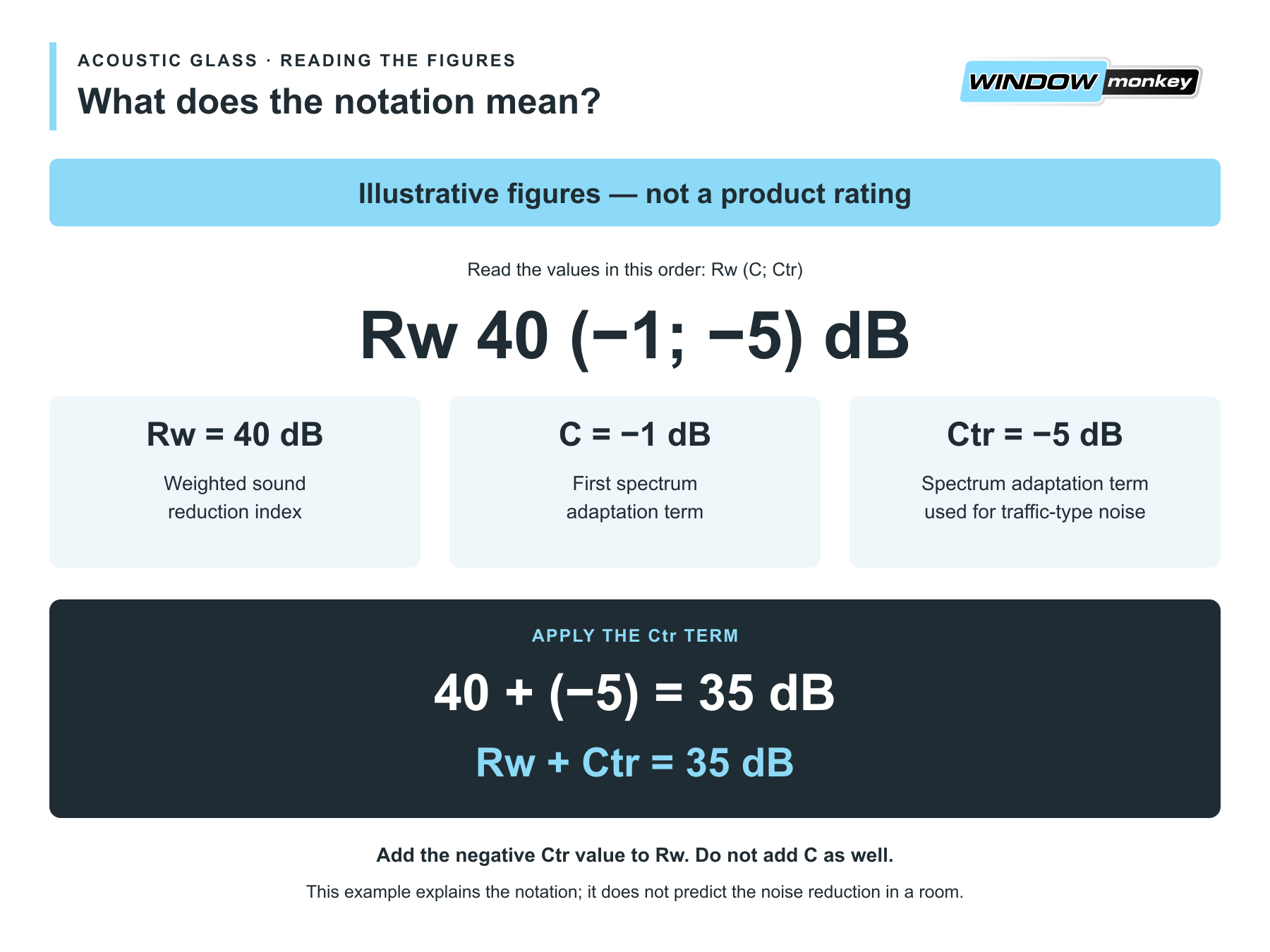
Rw is a weighted sound reduction index expressed in decibels. It summarises laboratory sound-insulation performance across a range of frequencies.
C and Ctr are spectrum adaptation terms added to Rw for different types of noise. Ctr is particularly relevant to urban road traffic with substantial lower-frequency content. The appropriate term still depends on the actual source: high-speed motorway traffic should not automatically be treated as the same spectrum as urban traffic. Pilkington noise-control FAQs.
For example, an illustrative rating of Rw (C; Ctr) = 40 (-1; -5) dB means C is -1 and Ctr is -5. The Rw + Ctr value is therefore 35 dB. These are invented numbers explaining the notation, not the declared performance of a product.
Compare like-for-like figures. A headline Rw value from one quotation and an Rw + Ctr value from another do not provide a fair comparison.
Specify the glass construction
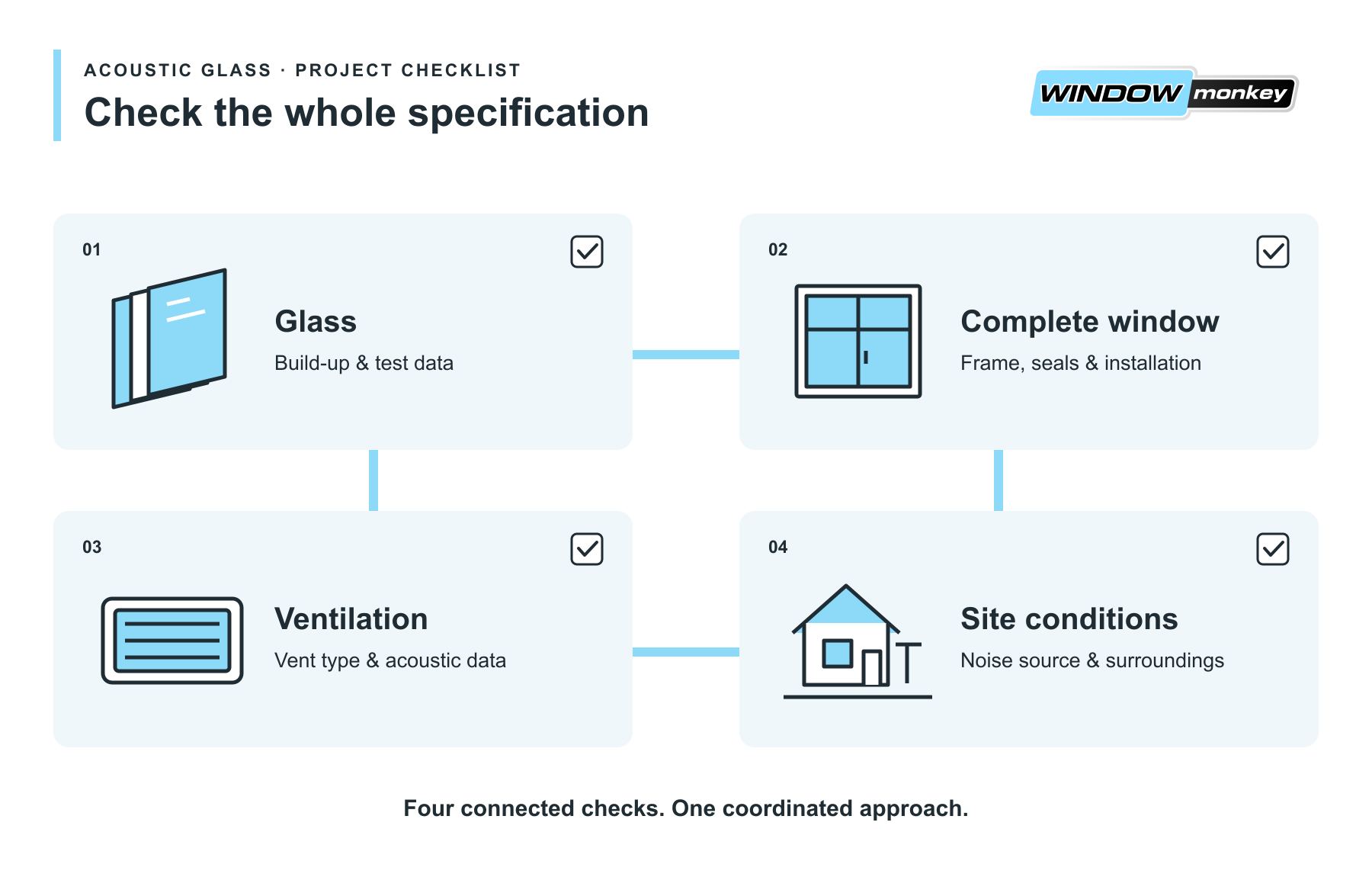
Ask for the actual glass make-up, including pane thicknesses, cavity and the named acoustic laminate where proposed. The words “double glazed”, “triple glazed” or “laminated” alone do not establish a particular acoustic result.
Different pane thicknesses and specialist acoustic interlayers are among the options used to improve sound insulation. Select using supporting data rather than assuming that an extra pane automatically makes the better acoustic choice. Saint-Gobain guidance on glass and acoustic insulation.
Manufacturer data should identify the configuration behind the figures. Saint-Gobain's acoustic calculator, for example, separates the glass construction, Rw, spectrum-adjusted values and frequency-band results, with certificate references. Use such data to inform the specification and request the evidence applicable to the proposed unit. Saint-Gobain acoustic calculator.
Check what has actually been tested
A glass result is not automatically a complete-window result. The frame, assembly and installation also influence acoustic performance. Ask the window supplier what evidence applies to the finished product, including its size, opening arrangement, glazing and seals. Saint-Gobain guidance on glass and acoustic insulation.
Keep three questions separate:
What is declared for the glass unit?
What is supported for the complete window configuration?
What performance is required from the finished room or facade?
A laboratory element rating is not a guaranteed reduction in noise inside a customer's room. Do not subtract the advertised glass rating from an outdoor reading and present the answer as a promised indoor level. Site prediction needs an appropriate acoustic assessment.
Include ventilation in the conversation
Discuss ventilation before presenting the acoustic package as complete. England's government guidance recommends noise-attenuating background ventilators for facades in noisy environments. Agree a suitable ventilation strategy for the project; simply blocking ventilation to reduce noise is not an appropriate solution. Government ventilation FAQs.
Check the exact ventilator and its intended operating condition. Ventilator data may use Dn,e,w, a different acoustic measure from a window's Rw. Open and closed results can differ substantially. Titon's technical catalogue presents these separately alongside ventilation data. Do not substitute a closed-vent figure for performance while the vent is providing background ventilation. Titon window and door hardware catalogue.
The customer's everyday use matters too. A closed-window acoustic specification does not describe performance with the sash open.
Prepare a quotation that can be checked
Give the customer a short written schedule stating the room, window reference, proposed construction and evidence being relied on. Identify any assessment still required and avoid unqualified claims such as “soundproof”.
Ask the supplier to confirm that the frame, glazing capacity and hardware accommodate the proposed unit. Agree the installation and perimeter-sealing details with the relevant suppliers. Where the project has a defined acoustic target, ask the consultant to consider other transmission paths, including adjacent construction and flanking routes.
Keep the agreed specification, supporting information and any substitutions together. If the glass or opening arrangement changes, confirm that the original performance evidence still applies.
Illustrative scenario: a bedroom beside a busy road
A builder in Aylesbury receives two quotations with different headline acoustic figures. One describes glass performance; the other includes a window configuration. The proposed ventilators also differ.
The builder first obtains comparable information, then asks an acoustic consultant to assess the demanding bedroom brief. The customer receives a coordinated proposal with stated conditions, rather than an unsupported promise of silence. This is an illustrative scenario, not a tested Window Monkey case study.
Frequently asked questions
Is triple glazing always better for traffic noise?
No. Compare the evidence for the proposed constructions and the relevant noise spectrum. Pane count alone does not establish acoustic performance.
Will acoustic glass make the room silent?
No specification should promise that. Results depend on the complete window, installation, ventilation, other sound paths and site conditions. Set expectations around an assessed project brief.
Can I keep the existing frames and change the glass?
Possibly, subject to assessment. Ask the supplier to check condition, unit thickness, weight, seals and hardware compatibility. Do not assume a glass-only upgrade will meet a complete-window or room-level target.
Discuss your customer's project
Bring the room brief, survey information and any acoustic consultant's specification to Window Monkey. We can discuss window supply options and check the available evidence with the relevant supplier.
WhatsApp 07942 334055 or visit our showroom in Leighton Buzzard. Supplying Milton Keynes, Luton, Aylesbury and surrounding areas.